
Secure Data Destruction Malaysia Quote: The Complete Pricing & Compliance Guide (2026–2027)
📊 Key Facts
- PDPA compliance and accurate budgeting require detailed understanding of data destruction pricing
- Three main destruction methods: software wiping, physical destruction, and degaussing have different costs
- Software-based wiping is most cost-effective for functioning drives destined for resale
- Financial institutions, healthcare, and multinationals face different regulatory requirements for data destruction
- Vague vendor quotes lacking device details lead to inaccurate pricing and compliance gaps
When Malaysian businesses start searching for a secure data destruction Malaysia quote, most expect a simple price list. What they often receive instead is a vague email asking for a “device count” — and nothing else. The result? Wildly inaccurate quotes, surprise charges on invoice day, and compliance gaps that expose the business to PDPA liability.
This guide changes that. Whether you are a finance institution governed by Bank Negara Malaysia (BNM) guidelines, a healthcare organisation handling patient records, or a multinational with GDPR obligations, understanding how data destruction is scoped, priced, and certified is the foundation of a sound IT asset disposal strategy.
1. The Three Core Data Destruction Methods — and Why It Matters for Pricing
Not every device needs the same treatment, and not every treatment costs the same. Here is how the three main methods compare:
Software-Based Data Wiping (Overwriting)
How it works: Specialised software overwrites every sector of a storage drive multiple times using recognised standards such as NIST 800-88 or DoD 5220.22-M. The drive remains physically intact and can often be resold or redeployed.
Best for: Functioning HDDs and SSDs destined for resale or internal redeployment.
Relative cost: Generally the most cost-effective option per unit when volumes are high, since the hardware retains residual value that can offset service fees.
Limitation: Cannot be applied to physically damaged drives, and verification requires detailed logs — which is where certified providers like KCOMSB add value over DIY approaches.
Degaussing
How it works: A powerful magnetic field disrupts the magnetic domains on hard disk drives and magnetic tape, rendering data irretrievable. The device is permanently destroyed — it cannot be powered on after degaussing.
Best for: Legacy HDDs, LTO tape libraries, and backup media where reuse is not required.
Relative cost: Mid-range. Degaussing equipment is capital-intensive, so per-unit pricing reflects equipment amortisation. Pricing typically scales by volume.
Limitation: Ineffective on SSDs, NVMe drives, and USB flash storage because these use NAND flash memory, not magnetic storage. A reputable provider will flag this upfront — be cautious of any vendor who offers degaussing as a universal solution.
Physical Shredding / Destruction
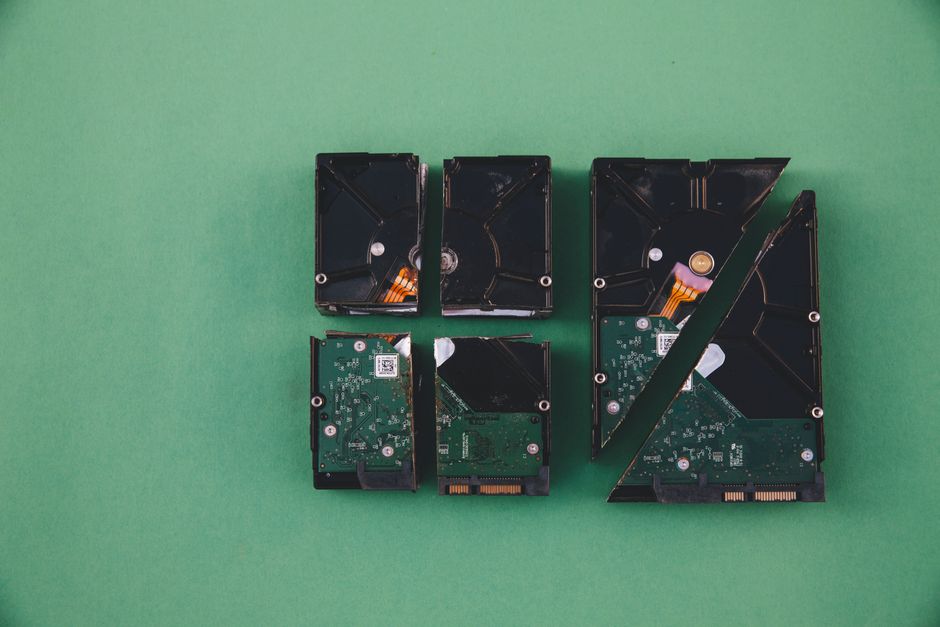
How it works: Drives, circuit boards, and storage media are fed through industrial shredders, reducing them to particles below a specified size (commonly 2mm for high-security classifications). Mobile on-site shredding units can perform this at your premises.
Best for: Devices that are damaged, have failed verification during wiping, or require the highest security classification (government, defence, banking).
Relative cost: Highest per-unit cost, particularly for on-site mobile shredding, but often the only compliant option for certain regulatory environments. Certificate of Destruction (CoD) is issued upon completion.
2. What Factors Actually Drive Quote Calculations?
When you request a secure data destruction Malaysia quote, vendors with transparent pricing models will ask you about all of the following before giving a number:
- Volume and device mix: Fifty laptops are priced differently from fifty servers. SSDs, HDDs, NVMe drives, and hybrid storage each require different handling.
- Device condition: Non-functional or water-damaged equipment may require manual disassembly before destruction, adding labour time.
- Destruction method required: As above, wiping, degaussing, and shredding carry different cost structures.
- On-site vs. off-site service: On-site destruction involves mobilising equipment and personnel to your location — this adds logistics cost but reduces chain-of-custody risk.
- Certification requirements: Clients requiring ISO 27001-aligned Certificates of Destruction, serialised asset tracking, and third-party audit trails will see this reflected in service scope.
- Volume of data-bearing components: A single desktop tower may contain one HDD — or, in some configurations, multiple SSDs. Per-device pricing versus per-storage-unit pricing can produce very different totals.
- Data classification level: High-security environments (financial records, healthcare data, government files) often require cross-cut shredding to smaller particle sizes, adding process time.
- Collection logistics: Distance from your site in Kuala Lumpur or beyond, number of collection points, and scheduling urgency all factor into final pricing.
A quote that ignores any of these variables is a placeholder, not a price.
3. Malaysian Regulatory Compliance: What Your Quote Must Reflect
Data destruction in Malaysia is not simply a physical process — it carries legal obligations that directly affect what service scope you need, and therefore what a compliant quote should include.
Personal Data Protection Act (PDPA) 2010 (Amended 2024)
Malaysia’s PDPA requires data processors to take practical steps to prevent unauthorised access, disclosure, or loss of personal data. Under the 2024 amendments, mandatory data breach notification within 72 hours has been introduced, raising the stakes for incomplete or non-certified destruction. If a device leaves your premises without documented, certified destruction, you bear liability.
Quote implication: Any PDPA-compliant quote should include a Certificate of Destruction with serialised asset tracking — not just a service receipt.
Bank Negara Malaysia (BNM) Data Handling Standards
BNM’s Risk Management in Technology (RMiT) policy document requires financial institutions to ensure secure disposal of information assets, including confirmation that data is irrecoverable. For banks, insurance firms, and licensed financial institutions, this means documented destruction with an audit trail.
Quote implication: Vendors serving BNM-regulated clients must demonstrate they can provide audit-ready documentation. If your quote does not mention this, ask for it explicitly.
ISO 27001 / ISO 27035
ISO 27001 (Information Security Management) and ISO 27035 (Incident Management) are internationally recognised standards that govern how organisations handle data throughout its lifecycle, including disposal. Many enterprise procurement teams and multinational clients require their vendors to hold or align with ISO 27001.
Quote implication: Ask whether the provider’s destruction process is conducted within an ISO 27001-aligned management framework, and whether this is reflected in the certification documentation you receive.
GDPR / LGPD (For Multinational Operations)
If your Malaysian operation serves EU data subjects or falls under Brazilian LGPD obligations, your data destruction practices must meet these frameworks’ standards as well. Cross-border data handling requirements add a layer of documentation complexity that should be scoped into any enterprise quote.
4. On-Site vs. Off-Site Destruction: A Real Cost-Benefit Comparison
This is one of the most common decisions businesses face — and one of the least transparently discussed in Malaysian vendor proposals.
| Factor | On-Site Destruction | Off-Site Destruction |
|---|---|---|
| Chain of custody risk | Minimal — you witness destruction | Higher — relies on vendor logistics protocols |
| Cost | Higher (mobilisation + equipment) | Lower per unit at scale |
| Verification | Immediate, witnessed | Via documentation and audit trail |
| Suitable for | Highly classified data, regulated industries | High-volume, lower-classification assets |
| Certificate issued | Yes, on the day | Yes, upon facility completion |
| Compliance suitability | BNM, government, healthcare | SMEs, general corporate IT refresh cycles |
For many Kuala Lumpur-based businesses, a hybrid approach works well: high-sensitivity drives are shredded on-site, while bulk low-classification assets are wiped off-site at a certified facility. A well-structured quote will give you line-item pricing for each option so you can make an informed allocation decision.
5. Can You Recover Value From Assets Being Destroyed?
Yes — and this is a point most vendors underemphasise in their quotes. When devices are still functional and destruction occurs via certified data wiping, the hardware retains market value. KCOMSB’s IT asset disposal process evaluates each device before destruction, identifying units that can be refurbished and remarketed. This residual value can partially or fully offset your data destruction service fee.
To understand how this works for your specific asset mix, start with a Free IT Asset Evaluation Malaysia Quote Online 2026-2027. This step — before committing to full destruction — can meaningfully change your total cost calculation.
For assets where data wiping is the appropriate method and devices will be redeployed or resold, KCOMSB’s Secure Data Erasure Service provides NIST 800-88-aligned overwriting with full certification documentation.
6. Timeline: From Quote Request to Certificate of Destruction
One of the most common questions we hear is: how long does this actually take? Here is a realistic timeline for a mid-sized corporate engagement in Malaysia:
- Day 1–2: Quote request submitted with complete device inventory and compliance requirements
- Day 3–5: Site survey (if on-site destruction is required) or asset collection scheduling confirmed
- Day 5–10: Service execution — wiping, degaussing, or shredding depending on method
- Day 10–14: Certificate of Destruction, serialised asset report, and data sanitisation report delivered
- Day 14–21: Final invoice and audit documentation package issued for compliance records
Urgent engagements — such as office closures, regulatory deadlines, or M&A transitions — can often be accelerated. Communicate your deadline upfront when requesting a quote so the provider can confirm feasibility.
7. What to Include in Your Quote Request (Avoid the Back-and-Forth)
To receive an accurate, binding quote rather than a ballpark estimate, provide the following in your initial request:
- Complete device inventory: Quantity, type (laptop, desktop, server, storage array), and approximate age
- Storage media breakdown: Number and type of drives per device (HDD, SSD, NVMe, hybrid)
- Device condition: Functioning, non-functional, or physically damaged
- Data classification level: General business data, personally identifiable information (PII), financial records, healthcare data
- Regulatory framework: PDPA, BNM, ISO 27001, GDPR — whichever applies to your organisation
- Preferred destruction method (or ask the vendor to recommend based on the above)
- On-site or off-site preference
- Required documentation: Certificate of Destruction format, serialised asset report, chain-of-custody log
- Timeline and location: Kuala Lumpur, Selangor, or elsewhere in Malaysia
- Residual value interest: Whether you want an asset valuation prior to destruction
A vendor who can respond to all ten points with specificity is a vendor operating a mature, compliant service.
8. Watch for These Hidden Costs in Data Destruction Quotes
Not all quotes reflect the final invoice. Common additions to watch for:
- Per-certificate fees: Some vendors charge separately for each Certificate of Destruction rather than including it as standard
- Disassembly labour: Devices with non-standard configurations may require manual disassembly before destruction
- Minimum quantity charges: A quote that looks attractive per unit may carry a minimum order value
- Report formatting fees: Detailed serialised reports or custom audit documentation are sometimes billed separately
- Logistics and fuel surcharges: Collection from multiple sites or remote locations outside Klang Valley may carry additional charges
- Re-collection fees: If assets are not ready on the agreed collection date, return visits are typically charged
Ask your vendor to provide an all-inclusive quote that specifies exactly what is and is not covered before you sign off.
Getting Your Secure Data Destruction Malaysia Quote Right, the First Time
A well-constructed secure data destruction Malaysia quote is not just a price — it is a compliance document in progress. It should reflect the destruction method appropriate to your data classification, the regulatory framework governing your industry, the documentation you will need for audit purposes, and an honest assessment of whether your assets carry any residual value worth recovering.
KCOMSB works with businesses across Kuala Lumpur and Malaysia to provide transparent, certified IT asset disposal and data destruction services aligned with PDPA, BNM guidelines, and ISO 27001 frameworks. Start with an asset evaluation to understand your options, or request a detailed scope-based quote that covers every line item before work begins.
As a service business, implementing proper cost management and automation tools can significantly improve your operational efficiency and profitability—explore service business automation tools to streamline your data destruction quoting process.
Get your Free IT Asset Evaluation Malaysia Quote Online and take the first step toward a compliant, cost-effective data destruction engagement.
